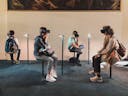
The Immersive, Inclusive, and Embedded Learning programme investigates how extended reality (XR), spatial computing, and sensor-based technologies can transform learning by embedding it directly within real-world and simulated environments. The programme futures builds on IET’s long-standing expertise in augmented, virtual, and mixed reality, and inclusive extending into new domains of accessibility, inclusion, and embodied cognition.
Our research explores how immersive technologies can support authentic learning-by-doing (also in different socio-economic contexts), enable empathy-rich simulations, and offer equitable access to complex or remote experiences. The ‘inclusive’ dimension addresses universal design, accessibility through XR and AI, and co-creation with learners from diverse backgrounds. The ‘embedded’ dimension focuses on seamless, Augmented Reality integration, where learning is not separate from work or play but occurs naturally within lived, spatially, and socially situated contexts.
The programme connects design research, performance analytics, and cognitive science with the social mission of the Open University, ensuring that the immersive revolution enhances—not replaces—human educators. It supports the Open University’s strategic priorities in innovation, inclusion, and lifelong learning, while contributing to global EdTech and XR standards.
Aligned with the Horizon Europe Work Programmes 2025–2027, the programme positions IET to lead and collaborate on large-scale projects in virtual worlds, spatial computing, AI-supported experiential learning, and equitable participation in digital futures.